
Call 214-506-0671


USCIS Memo on Good Moral Character: What Green Card Holders Should Know Before Applying for Citizenship
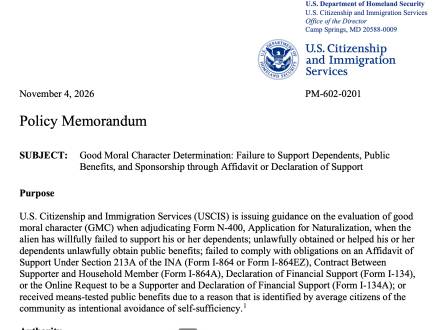
On November 4, 2026, U.S. Citizenship and Immigration Services (USCIS) issued Policy Memorandum PM-602-0201. The memo explains how officers will evaluate good moral character (GMC) when they review a Form N-400, Application for Naturalization. It covers four areas: willful failure to support dependents, unlawful public benefits conduct, failure to meet Affidavit of Support obligations, and receipt of means-tested benefits for reasons the community may see as avoiding self-sufficiency. For lawful permanent residents, the memo has direct consequences. Many green card holders have sponsored relatives, supported children abroad, or used public benefits for their households. Those facts may now receive closer review when the applicant files for citizenship.
Why Good Moral Character Matters for Naturalization
An applicant must establish GMC during the statutory period. In general, that period is the five years before filing, or three years for certain spouses of U.S. citizens. The memo confirms that the applicant carries the burden of proof by a preponderance of the evidence. Conduct before the statutory period can still matter if it shows the applicant's present character or if the applicant has not reformed. GMC does not mean moral excellence, and a single lapse does not automatically defeat it. The question is whether the applicant's overall conduct meets the standards of average citizens in the community.
Willful Failure to Support Dependents
The memo states that willful failure to support dependents is a conditional bar to GMC. Unless the applicant shows extenuating circumstances, an officer may find a lack of GMC when the applicant deserts a minor child, pays no support for a dependent, or pays an amount that is clearly insufficient under a court order or community standards. The memo also says that a parent has a moral and legal duty to support minor children even when no court order exists.
The memo also addresses dependents who receive means-tested benefits. It states that a dependent's receipt of benefits does not automatically bar naturalization. However, depending on the circumstances, heavy reliance on those benefits may show that the applicant did not meet a parent's responsibilities. Officers must look at the full picture before drawing that conclusion.
Sponsors and the Affidavit of Support
This section will likely matter most to green card holders who sponsored a family member. The memo notes that a U.S. citizen, U.S. national, or lawful permanent resident who signs Form I-864 agrees to provide support at an annual income of at least 125 percent of the federal poverty line. A household member who signs Form I-864A takes on joint and several liability for the same obligation. The memo states that if a sponsor fails to meet these obligations, especially when the sponsored person receives means-tested benefits during the enforceability period, officers may treat this as a negative factor when assessing the sponsor's GMC.
The memo includes a helpful limit. Benefit income thresholds can be higher than the Form I-864 requirement, so a sponsor may still have met the obligation even though the sponsored person received a benefit. Records that show the sponsor's income and support can make that point clear.
The memo also mentions Form I-134 and Form I-134A. Those forms do not carry a statutory support duty, but willful failure to support a person under them still weighs against character. USCIS paused acceptance of Form I-134A on January 28, 2025, but obligations signed before that date remain relevant.
Public Benefits Fraud
Receiving public benefits does not, by itself, prevent naturalization. Fraud or deception in applying for or receiving benefits is a different matter. The memo lists examples, including false information about income or household size, unauthorized receipt of benefits, failure to report changes that affect eligibility, and use of multiple identities. Fraud involving benefits may qualify as a crime involving moral turpitude, and even without a conviction, it can prevent a finding of GMC. If the conduct happened before the statutory period, it can still count as a negative factor in the overall review.
The memo gives a specific example. If a sponsored person does not tell the benefit agency about the sponsor's or a household member's support obligation, officers may treat that omission as misconduct.
Intentional Avoidance of Self-Sufficiency
This is the most debated part of the memo. The memo says an officer may view means-tested benefit use as adverse to GMC when the applicant benefits for a reason average citizens would see as intentional avoidance of self-sufficiency. Its main example is an applicant who stops working or significantly cuts hours after learning of benefit eligibility, for reasons other than a legitimate personal or medical need.
The memo also sets clear limits. Officers must perform an individualized, case-by-case review that considers the reason for benefit use, the applicant's efforts toward self-sufficiency, and any evidence of rehabilitation or positive contributions. Any adverse finding must rest on specific conduct, not on poverty, disability, or lawful benefit receipt. The memo states that this factor is never an automatic disqualifier. It also recognizes that in communities where many residents receive means-tested benefits, the applicant may meet the community standard.
What the Memo Does Not Settle
Several points remain open, and applicants should be honest with themselves about them.
First, the memo is guidance for USCIS officers. It states that it does not create enforceable rights for applicants and does not remove officers' authority to make decisions. Second, USCIS says it will draft new Policy Manual content and revise Form N-400 to collect more information about benefit use and dependent support. The memo does not give a timeline, and the new form questions are not yet public. Third, key terms such as "average citizen" and "intentional avoidance of self-sufficiency" are fact-specific. Outcomes may vary between officers and offices, and some of these questions may later be tested in court. This memo also follows an August 2025 memo, PM-602-0188, which already called for a more rigorous and holistic GMC review.
Practical Steps for Green Card Holders Before Filing
- Collect proof of support for any child or dependent, in or outside the United States. Useful records include bank transfers, money order receipts, court orders, and written agreements.
- If you signed an Affidavit of Support, locate your copy and confirm whether the enforceability period is still running. Keep records of any benefits the sponsored person received.
- Review your benefit history, including income, household size, and changes you reported. Make sure every household member was listed accurately.
- If you reduced work hours or income in connection with benefit eligibility, document the real reason, such as a medical condition, caregiving, schooling, or safety concerns.
- Do not assume that receiving benefits disqualifies you. The memo says lawful receipt is not a bar on its own.
- Expect the revised N-400 to ask more questions. Prepare complete and consistent answers now, and keep copies of everything you submit.
- Speak with an immigration attorney before you file if any of these issues apply. A GMC finding can lead to denial, and the facts on a naturalization case should be reviewed carefully before the application is filed.
Take the Next Step
If you are thinking about applying for citizenship, start with a short review this week. List every dependent you support, every Affidavit of Support you signed, and every public benefit your household has used in the past five years. Then gather the records for each item, such as bank transfers, court orders, and benefit notices. The sooner you find a gap, the more time you have to explain it or correct it before you file.
If you have questions about how this memo may affect your naturalization application, you are invited to book a consultation with our attorneys. We represent clients nationwide. Asking questions before you file can help avoid denials or delays in your case.
