
Call 214-506-0671


Supreme Court Upholds Birthright Citizenship: What the Ruling Means for Immigrant Families
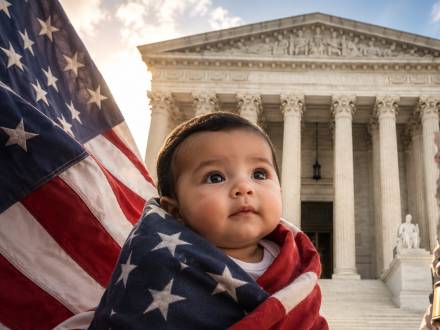
On June 30, 2026, the Supreme Court ruled in Trump v. Barbara that children born in the United States are citizens at birth under the Fourteenth Amendment, regardless of their parents' immigration status. The decision strikes down Executive Order 14160, which President Trump signed on his first day in office in an attempt to deny citizenship to children born to parents who are undocumented or present on temporary visas.
For families who have spent the past year and a half uncertain about what this order meant for their children, the ruling resolves the central legal question. Birthright citizenship remains the law of the land.
What the Court Decided
The Citizenship Clause of the Fourteenth Amendment states that all persons born in the United States and subject to its jurisdiction are citizens. Chief Justice John Roberts wrote the majority opinion, joined by Justice Amy Coney Barrett and the Court's three liberal justices, Elena Kagan, Sonia Sotomayor, and Ketanji Brown Jackson. The majority held that children born here to parents who are unlawfully or temporarily present are subject to United States jurisdiction and are citizens at birth, consistent with the Court's 1898 decision in United States v. Wong Kim Ark.
Justice Brett Kavanaugh provided the sixth vote against the executive order, but he reached that result on narrower grounds. Rather than rule on the constitutional question, he concluded that the order conflicts with a federal statute from 1940 governing citizenship at birth. His vote means six justices agreed the executive order cannot stand, though only five agreed on why.
Justices Clarence Thomas, Neil Gorsuch, and Samuel Alito dissented. Justice Alito, writing separately, called the decision one of the most consequential in the Court's history and argued the ruling preserves an incentive for unlawful entry into the country.
Trump's Response and Why It Misreads the Constitution
Following the ruling, President Trump posted on Truth Social that he was unconcerned by the outcome. He stated that Congress could resolve the issue through ordinary legislation with his support, and that a constitutional amendment was not necessary.
This claim does not hold up under basic constitutional principles. The Fourteenth Amendment is part of the Constitution itself. Under the Supremacy Clause and more than two centuries of judicial review dating back to Marbury v. Madison, any statute that conflicts with the Constitution is void. Congress cannot pass a law that overrides a constitutional guarantee. That is true of birthright citizenship just as it is true of any other right the Constitution protects.
If the executive branch wants to change who qualifies for citizenship at birth, the path is not legislation. It is a constitutional amendment. That requires a two-thirds vote in both the House and the Senate, followed by ratification from three-fourths of the states, currently 38 of 50. No effort to amend the Constitution in this way has succeeded in over fifty years, and nothing about the current political landscape suggests this would be the exception.
It is worth noting that Justice Kavanaugh's concurrence leaves open a narrower statutory question involving the 1940 nationality law, separate from the constitutional holding. That question may generate future litigation, but it does not change the core point. The constitutional guarantee of birthright citizenship, as interpreted by five members of the Court, cannot be undone by an ordinary act of Congress.
What This Means Going Forward
For now, the law remains unchanged. A child born in the United States is a citizen at birth, regardless of the immigration status of their parents. Families who were concerned about how this order might affect a child's citizenship, eligibility for a Social Security number, or ability to obtain a passport can rely on the law as it has existed for over a century.
We expect to see continued political pressure around this issue, including possible legislative proposals in Congress. Those proposals may raise narrower statutory questions, but they cannot eliminate a right guaranteed by the Constitution itself. If you have questions about how this ruling affects your family's immigration status or a pending case, our office is available to help.
