
Call 214-506-0671


What are you actually signing when ICE asks you to agree to leave?
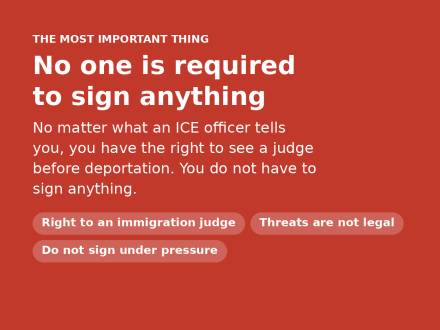
ICE is showing up with paperwork and telling people it is "for your deportation." But not all documents are the same, and no one is required to sign anything. Here is what you need to know before you put your name on anything.
The Department of Homeland Security is ramping up arrests across the country. When people are detained, ICE officers are showing up with paperwork and pressuring them to sign. Some of these documents give up your right to go before an immigration judge. Others do not. Knowing the difference could change the rest of your life.
What does a removal order actually mean?
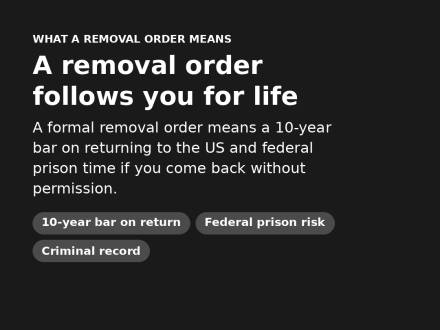
Before going through each document, it helps to understand what a removal order does — because avoiding one is the main reason DHS uses these agreements as leverage.
Important: Choosing to leave voluntarily to avoid a removal order does not mean you will automatically have a pathway to come back. Most people who lived in the US without status for more than one year still face a separate 10-year bar, even without a formal removal order on their record.
The 6 documents ICE may ask you to sign
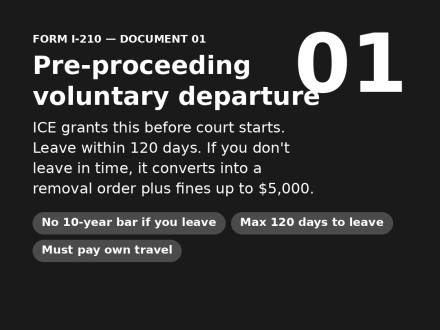
01 — Pre-Proceeding Voluntary Departure (Form I-210)
ICE can grant this on their own before a court case has started. You agree to leave within 120 days, usually paying for your own travel. It avoids a formal removal order, but if you fail to leave in time, it converts into one, plus civil fines up to $5,000.
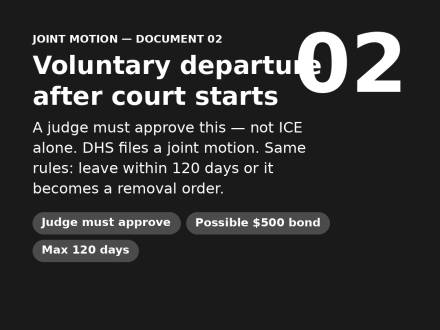
02 — Voluntary Departure After Court Starts (Joint Motion)
If a court case has already been filed, an immigration judge, not ICE alone, must approve voluntary departure. DHS may file a "joint motion" the judge can approve without a hearing. Same rules: leave within 120 days or it becomes a removal order.
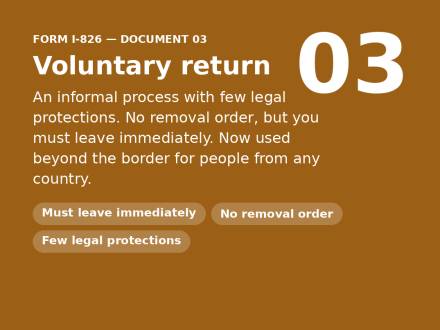
03 — Voluntary Return (Form I-826)
An informal process historically used at the border for people who could cross back to Mexico or Canada immediately. There is no formal removal order, but you must leave right away. ICE is now using it more broadly, including for people from other countries, with few legal protections attached.
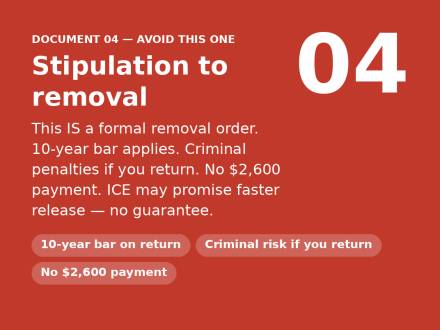
04 — Stipulation to Removal (Avoid This One)
This is an agreement that you will receive a formal removal order. That means the 10-year bar, criminal penalties if you ever return, and no timeline guarantee for leaving detention. ICE may tell you it will get you out faster, but there is no guarantee. You will also not be eligible for the $2,600 payment DHS offers through other programs.
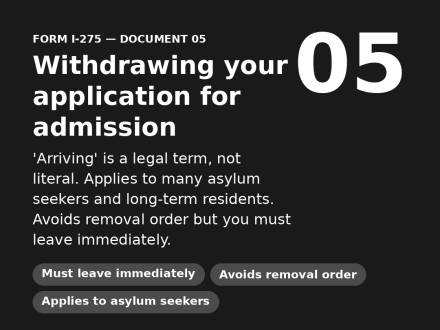
05 — Withdrawing Your Application for Admission (Form I-275)
"Arriving" is a legal definition, not a literal one. Many people who have lived in the US for years, including many asylum seekers who came through programs like CHNV or CBP One, fall into this category. Withdrawing your application means agreeing to leave immediately without a removal order, but it does not clear other bars to returning.
05 Form I-275 — for "arriving" persons Withdrawing your application for admission "Arriving" is a legal definition, not a literal one. Many people who have lived in the US for years, including many asylum seekers who came through programs like CHNV or CBP One — fall into this category. Withdrawing your application means agreeing to leave immediately without a removal order, but it does not clear other bars to returning. Must leave immediately Avoids removal order Applies to many asylum seekers
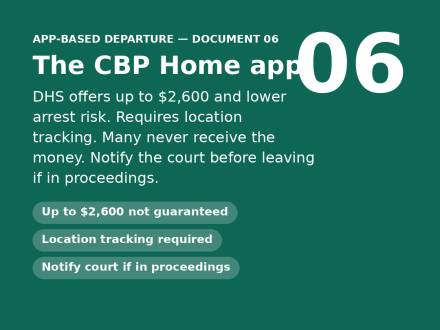
06 — The CBP Home App
DHS is offering up to $2,600 and a lower risk of arrest to people who use this app to leave voluntarily. It requires registering with the government and sharing your location. Many people report never receiving the money promised. If you are already in removal proceedings, leaving without notifying the immigration court could result in an in absentia removal order, meaning you get ordered deported without being present.
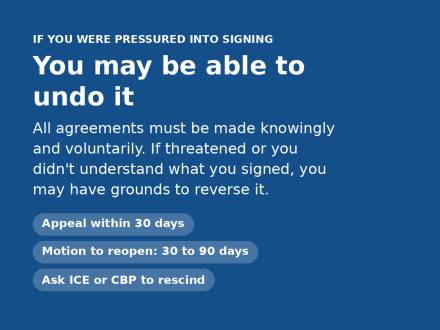
If you were pressured or tricked into signing
We have seen ICE officers show people only the signature line of a document, refuse to translate it, or tell them they have no choice but to sign. That is not legal — and it may be grounds to undo what was signed.
All of these agreements must be made "knowingly and voluntarily." If you did not understand what you were signing, or if you were threatened, you may have grounds to reverse the agreement.
- Under 30 days since signing: Appeal to the Board of Immigration Appeals. State clearly that you did not sign knowingly or voluntarily.
- 30 to 90 days since signing: File a motion to reopen with the immigration court. Act quickly. Time limits are strict.
- If ICE or CBP issued it directly: Contact that agency and request they rescind the agreement.
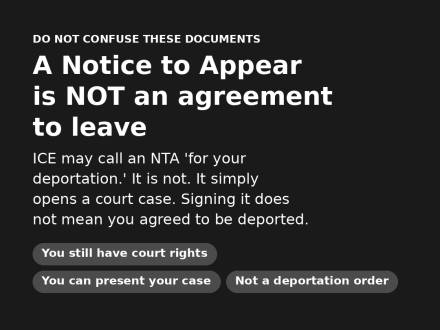
A Notice to Appear is not an agreement to leave
ICE officers sometimes tell people that signing a Notice to Appear (NTA) is "for their deportation." It is not. An NTA is simply the document that opens a removal case in immigration court. Signing it does not mean you agreed to be deported. You still have the right to go before a judge and present your case.
You can check whether an NTA has been filed by calling the EOIR case information hotline: 1-800-898-7180.
Speak with an immigration attorney as soon as possible
If you or a loved one has been detained, shown paperwork by ICE, or signed a document you did not fully understand. Time matters. The windows to appeal or reopen your case are short, and every day counts.
