
Call 214-506-0671

US Visa Applicants Must Now Make Social Media Profiles Public. Are You Ready?
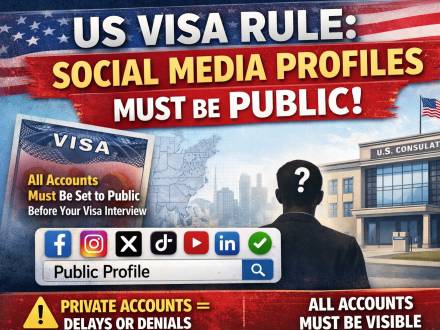
If you are applying for a US visa right now, there is a new rule you need to know about before your interview.
The US Department of State now requires certain visa applicants to set all of their social media profiles to public before their consular interview. This is not optional. If your profiles are private, or if you do not disclose your accounts, your visa could be delayed — or denied.
This rule has been expanding fast. It started in June 2025 for students and exchange visitors, grew in December 2025 to include H-1B workers, and expanded again in March 2026 to cover a much wider group of visa categories. If you have an upcoming visa interview, this may already apply to you.
Which Visas Are Affected?
As of right now, the following visa categories are required to have their social media profiles set to public:
Since June 2025:
- F visa (academic students)
- M visa (vocational students)
- J visa (exchange visitors)
Since December 15, 2025:
- H-1B (specialty occupation workers)
- H-4 dependents of H-1B holders
Since March 30, 2026:
- A-3 (personal employees of foreign government officials)
- C-3 domestic workers
- G-5 (personal employees of international organization staff)
- H-3 (trainees)
- H-4 dependents of H-3 holders
- K-1 (fiancé(e) of a US citizen)
- K-2 (children of K-1 visa holders)
- K-3 (spouse of a US citizen)
- Q (cultural exchange)
- R-1 (religious workers)
- R-2 (dependents of R-1 holders)
- S (informants)
- T (trafficking victims)
- U (crime victims)
If your visa category is on this list, this rule applies to you now.
Why Is the Government Doing This?
The State Department says this expanded screening is about national security. By reviewing social media activity, consular officers can get a fuller picture of who someone is, what they believe, and whether there is anything in their background that might make them inadmissible to the United States. This is part of a broader push under the current administration to tighten the vetting process for anyone entering the country.
What Do You Need to Do?
Here is what every affected applicant should do right now:
1. Set all your social media profiles to public. This includes every platform — Instagram, Facebook, X (formerly Twitter), TikTok, LinkedIn, YouTube, and any others you use. Do this as early as possible, not the night before your interview.
2. List every account you have used in the last five years on your Form: This includes accounts you no longer actively use. If you used it in the past five years, it needs to be disclosed. Leaving out an account — even one you forgot about — can create serious problems.
3. Do not delete your accounts. It might seem like the easy solution, but deleting accounts shortly before your interview can raise red flags with consular officers. It can look like you are hiding something. Leave your accounts up.
4. Keep your profiles public until your visa is approved. There is no official date when you can switch back to private. The safest approach is to keep everything public until you have a final decision on your application.
5. Review your content. You do not need to delete old posts, but it is worth being aware of what is publicly visible. Posts that could be misread as hostile, politically sensitive, or contradictory to the information in your visa application could create complications.
What Happens If You Do Not Comply?
Failing to make your profiles public, or failing to disclose your accounts on your DS-160, can result in extended delays in processing or an outright visa denial. Consular officers have wide discretion in how they interpret what they see and what they cannot see. An unavailable profile does not look neutral. It looks like something is being hidden.
This Is Moving Fast — Stay Ahead of It
Immigration policy is changing faster than most people can keep up with. What was true six months ago may not be true today. If you have a visa interview coming up, do not assume you already know all the requirements.
At Hafey & Karim, we stay on top of these changes every day so our clients do not get caught off guard. If you are navigating a visa application right now and you are not sure whether this rule applies to you, or you want to make sure your application is as strong as possible, we are here to help.
Call us at 214-506-0671 or book a consultation today.


Our firm provides representation for people throughout the United States. From our Concord office, we serve clients in San Francisco, Oakland, San Rafael, San Pablo, Richmond, Berkeley, Alameda, San Leandro, Hayward, Fremont, San Bruno, San Mateo, Palo Alto, San Jose, Mountain View, Milpitas, Cupertino, Santa Clara, and Campbell. Additionally, we serve clients in Texas cities including, Plano, Frisco, Allen, Carrollton, Farmers Branch, Richardson, Garland, Mesquite, Irving, Grand Prairie, Arlington, Euless, Bedford, Grapevine, Coppell, and Fort Worth.
Results listed are not a guarantee or indication of future case results.